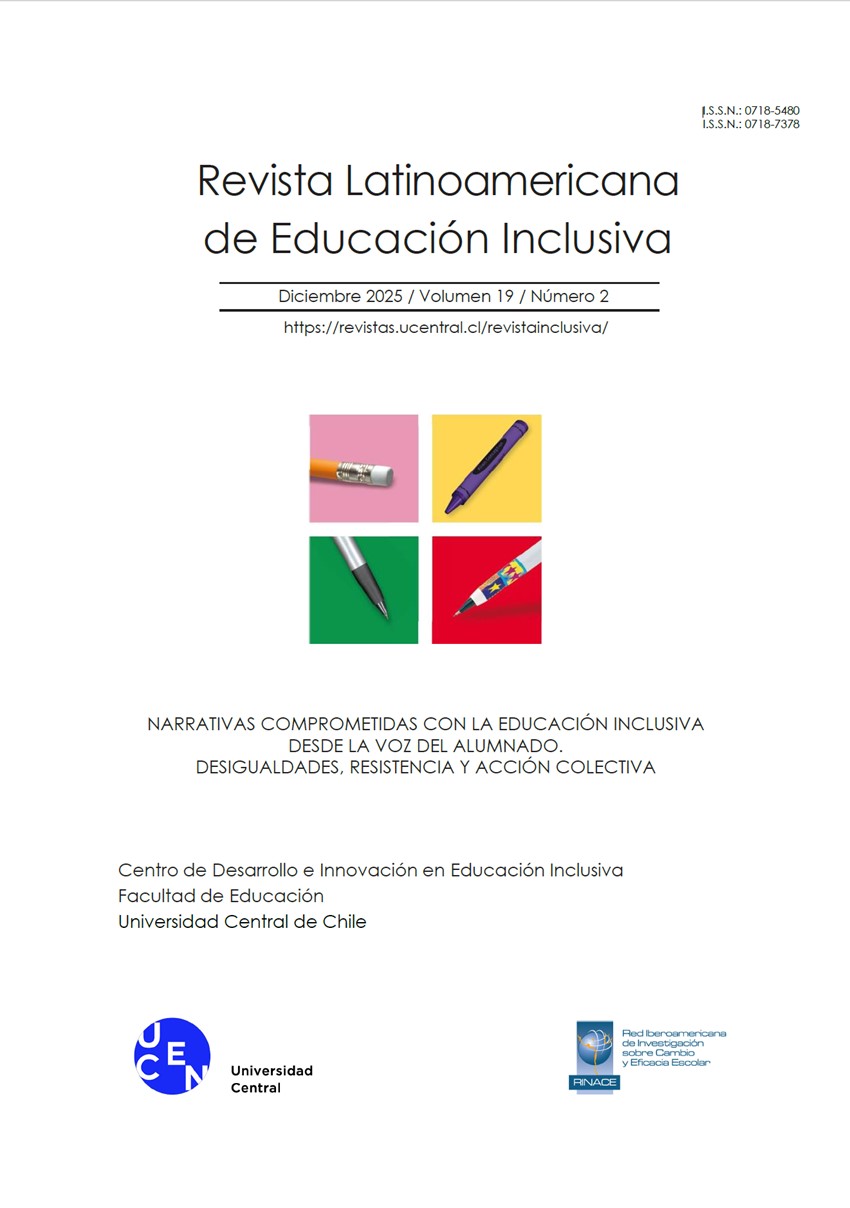
Narratives Committed to Inclusive Education from the Students, Voices. Inequalities, Resistance, and Collective Action
DOI:
https://doi.org/10.4067/S0718-73782025000200017Keywords:
Inclusive education, Student voice, Educational inequalities, Resistance, Collective actionAbstract
The project to make schools inclusive did not arise on a whim or as a passing fad. It was born in response to the collective desire for education systems around the world to accommodate all children, without exception, something that was addressed at the well-known World Conference held in Jomtien (UNESCO, 1990). A few years later, inclusive education emerged at the World Conference in Salamanca as the best way to achieve this goal (UNESCO, 1994). A decade later, inclusive education would be considered a fundamental human right (UN, 2006).
These three milestones have been fundamental, yes. However, the revolutionary project of making our schools inclusive has been devalued over time. Today, inclusive education is even used to refer to exclusionary practices, far removed from that desire. In many places, language is perverted, twisted to the point of robbing the project of its human value. In others, the use of certain words that link human diversity to the fight against inequality is even prohibited. Our differences become the target to be knocked down by the ultra-conservative agenda here and there, which highlights their transformative potential.
References
Ainscow, M., Calderón-Almendros, I., Duk, C., & Viola, M. (2025). Using professional development to promote inclusive education in Latin America: possibilities and challenges. Professional Development in Education, 51(1), 149-166. https://doi.org/10.1080/19415257.2024.2427285
Ainscow, M. y Messiou, K. (2018). Engaging with the views of students to promote inclusion in education. Journal of Education Change, 19, 1-17. https://doi.org/10.1007/s10833-017-9312-1
Castells, M. (1997). El poder de la identidad. Alianza.
Fielding, M. (2004). Transformative approaches to student voice: Theoretical underpinnings, recalcitrant realities. British Educational Research Journal, 30(2), 295-311. https://doi.org/10.1080/0141192042000195236
Fielding, M. (2010). The radical potential of student voice: Creating spaces for restless encounters. International Journal of Emotional Education, 2(1), 61-73.
Fielding, M. (2011). La voz del alumnado y la inclusión educativa: Una aproximación democrática radical para el aprendizaje intergeneracional. Revista Interuniversitaria de Formación del Profesorado, 70(25,1), 31-61.
Fielding, M. (2012). Beyond student voice: patterns of partnership and the demands of deep democracy. Revista de Educación, 359, 45-65. https://doi.org/10.4438/1988-592X-RE-2012-359-195
ONU. (2006). Convención de las Naciones Unidas sobre los Derechos de las Personas con Discapacidad. ONU.
Skliar, C. (2010). De la razón jurídica hacia una ética peculiar. A propósito del informe mundial sobre el derecho a la educación de personas con discapacidad. Política y Sociedad, 47(1), 153-164.
Soldevila, J., Calderón, I. y Echeita, G. (2024). Mi vida (escolar) es prescindible: radicalizar un discurso contra las miserias del sistema escolar. En J. Collet, M. Naranjo y J. Soldevila (Eds.), Educación inclusiva global (pp. 41-62). Octaedro. http://doi.org/10.36006/09627-1
UNESCO. (1990). Conferencia Mundial sobre Educación para Todos: Satisfacción de las necesidades básicas de aprendizaje. UNESCO.
UNESCO (1994). Conferencia Mundial sobre Necesidades Educativas Especiales: Acceso y calidad. UNESCO.
Published
How to Cite
Issue
Section
License
Copyright (c) 2025 Revista Latinoamericana de Educación Inclusiva

This work is licensed under a Creative Commons Attribution 4.0 International License.
Creative Commons Attribution (by)
This licence permits the exploitation of the work, as well as the creation of derivative works, the distribution of which is also permitted on condition that express reference is made to the author, i.e. that his/her name appears in any use or act of exploitation of the work.